OpenAI introduces ChatGPT Atlas – the conversational approach to search begins

Alistair Hague
Alistair Hague is Senior Partner for AI & Automation at Open Partners, with 27 years of international expertise spanning digital marketing, search, and web strategy.
OpenAI’s launch of the ChatGPT Atlas browser is a shot across the bow for Google and a big moment for mainstream user interaction with AI. In July, we wrote about the launch of Perplexity’s Comet browser and the chain reaction it would trigger with the two major players in the space, OpenAI and Google. OpenAI got there first.
What this means for UK search behaviour
In the UK, Google accounts for over 85% of search engine use. That dominance supports huge ad spend and underpins most digital marketing strategies. But Atlas could start to change user behaviour. Instead of scanning ten blue links, users might just get a clear, conversational answer and act on it.
Fewer clicks. Less friction. Faster decisions.
Enter the AI agent
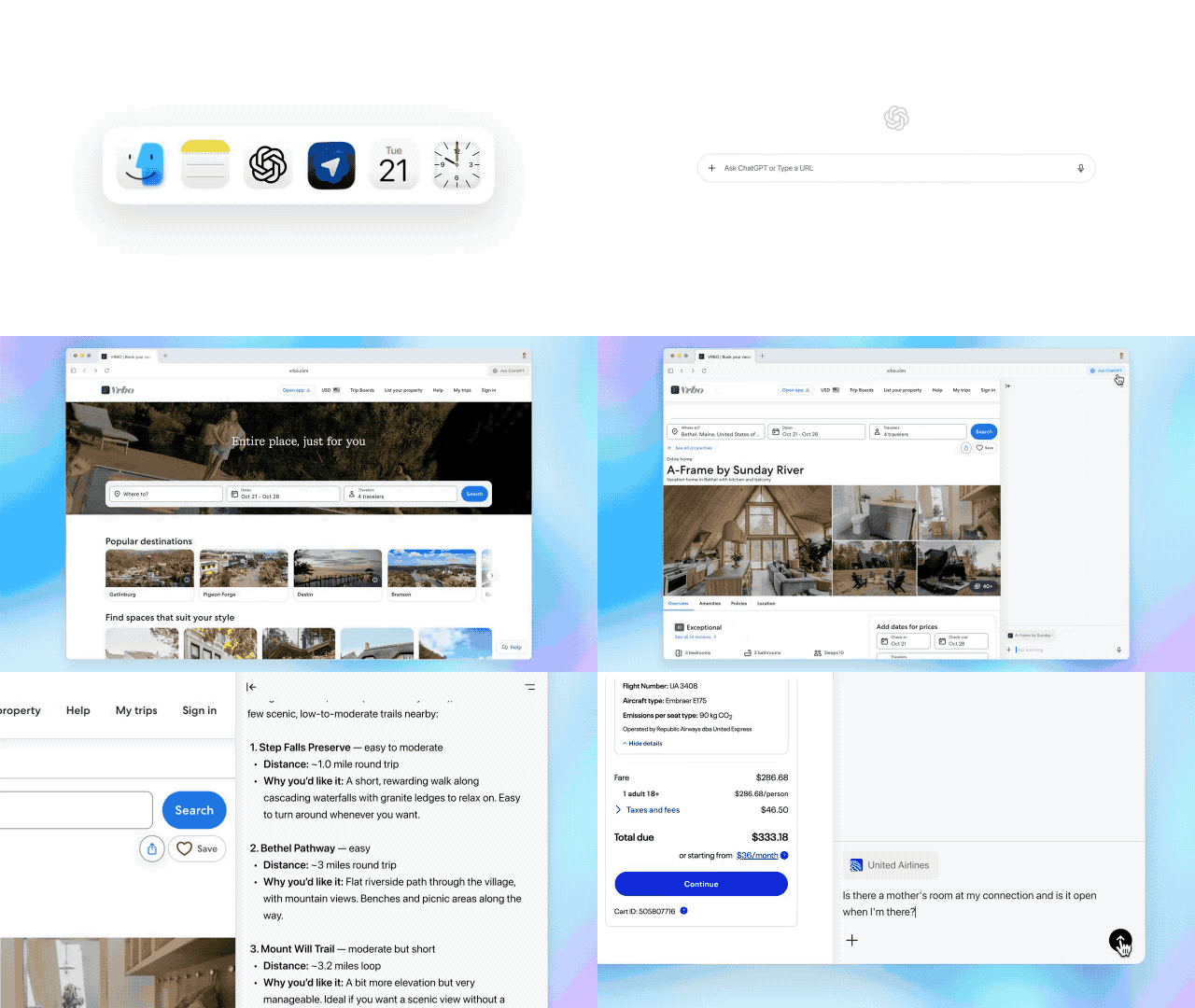
Atlas also introduces “agent mode.” Users can ask the browser to do things for them like book travel, shop for groceries, summarise a webpage and even plan an itinerary. All done via a conversational assistant. New UX? Yes. But also a whole new model of customer interaction.
If users buy into it, the implications are massive. Search traffic patterns will shift. The role of top ranking content will decline. Users might never see your carefully crafted landing page, they’ll just take the AI’s summary and move on.
Advertising is about to get a shake-up
That also changes the ad game. Google’s pay-per-click empire relies on search results and clicks. But if people ask Atlas instead, where do the ads go? And if OpenAI starts monetising its answers through sponsored results or recommendations, it creates a new battleground for visibility.
That’s something we should all watch closely. For now, Atlas is ad-free. But it’s only a matter of time. Brands that want to stay ahead will need to start thinking about visibility within the conversation, not just next to it.
Content strategy needs a rethink
Which brings us to content. Old search tactics don’t cut it. We’re moving into the era of GEO. Generative Engine Optimisation is an evolution of SEO.
AI tools like ChatGPT pull from reliable, well structured content underpinned by GEO signals. Not keyword stuffed blog posts. Think clear FAQs, structured data, clean summaries. If the AI can’t parse your content quickly, you’re invisible.
This shift is already happening. Early data shows that overlap between top Google results and AI-cited sources is dropping fast. The best-performing content needs to be well written and highly relevant while also being machine-readable.
To continue performing well, content will have to be more personalised and localised than ever before. Coherent and consistent, not just in and of itself, but as a touchpoint in an ever-evolving user journey.
AI increasingly interprets brands as multi-platform entities, weighing the strength of third-party validation as much as onpage optimisation. Consistency across social presence, community spaces, PR and impactful, industry-relevant citations is critical.
It’s classic authority building, but now for an algorithm that learns and builds sentiment relationally and semantically rather than indexically. And we’ve seen this play out repeatedly across GEO strategy evidence.
Attribution and analytics: the next frontier
What about measurement? That’s another challenge. If users convert via an AI assistant, your analytics may show a gap. Fewer clicks. Unknown referrers. It makes attribution harder. So marketers will need to invest more in first-party data and be ready to work with new AI reporting tools.
Integrating with the AI economy
Atlas also opens a broader question. How do you engage when the AI is the interface? Brands may need to offer integrations, APIs or real-time product data feeds that plug into the assistant directly. Otherwise, your offering might never reach the user.
While there are challenges ahead, there are also exciting opportunities for proactive responses. Open Partners’ AI search expert Lidia Facchinello says:
“We’re entering the age of agentic AI. A world of hyper-personalised, discursive search. User journeys will stretch across prompts, preferences and plugins, compressing discovery and decision-making into one seamless flow.
For organic strategy, that’s exhilarating. It means we can simulate persona journeys, test prompts at scale and forecast visibility in ways traditional analytics could never touch. The challenge and opportunity lie in understanding how memory, context and individuality will reshape the metrics of search itself.
But to thrive in that future, brands need to cement strong GEO authority today, grounded in rigorous SEO fundamentals, structured signals and content optimised at page, platform and prompt level, with credible multi-platform presence that LLMs can recognise and retrieve.”
What now?
This new browser represents a significant shift in how people search, decide and act online. It’s early days and adoption will take time, but the direction of travel is clear.
Smart brands will adapt now. That means:
Making content structured and AI-friendly
Watching how ad ecosystems evolve
Experimenting with integrations and conversational commerce
Doubling down on data strategy
If your customers start asking AI instead of searching Google, the cost of standing still is visibility.
Atlas is the first serious signal that the future of search might not be search at all. It might be conversation. And that changes everything.